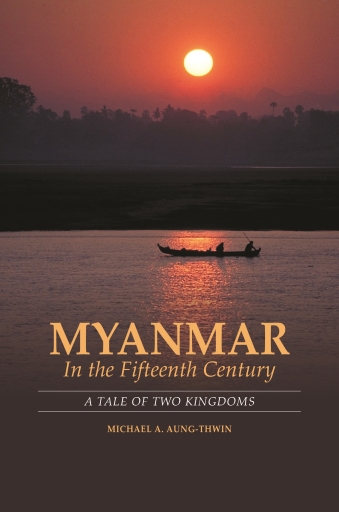
Myanmar in the Fifteenth Century
Published by University of Hawaii Press
English
2017
ISBN 9780824874124
eBook
Buy at Ebooks Yenny - El Ateneo
🇦🇷
 Association of University Presses - Tienda FILUNI
🇺🇸
Visit store →
Association of University Presses - Tienda FILUNI
🇺🇸
Visit store →
 Bajalibros Argentina
🇦🇷
Visit store →
Bajalibros Argentina
🇦🇷
Visit store →
 Bajalibros Latam
🇺🇸
Visit store →
Bajalibros Latam
🇺🇸
Visit store →
 Bookshop Uruguay
🇺🇾
Visit store →
Bookshop Uruguay
🇺🇾
Visit store →
 Catademic
🇺🇸
Visit store →
Catademic
🇺🇸
Visit store →
Available at 13 bookshops
Association of University Presses - Tienda FILUNI
🇺🇸
Visit store →
Bajalibros Argentina
🇦🇷
Visit store →
Bajalibros Latam
🇺🇸
Visit store →
Bookshop Uruguay
🇺🇾
Visit store →
Catademic
🇺🇸
Visit store →








About this book
When the great kingdom of Pagan declined politically in the late thirteenth and early fourteenth centuries, its territory devolved into three centers of power and a period of transition occurred. Then two new kingdoms arose: the First Ava Dynasty in Upper Myanmar and the First Pegu Dynasty in Lower Myanmar. Both originated around the second half of the fourteenth century, reached their pinnacles in the fifteenth, and declined before the first half of the sixteenth century was over. Their story is the only missing piece in Myanmar’s mainstream historiography, a gap this book is designed to fill.
Renowned historian Michael Aung-Thwin reconstructs the chronology of this nearly two-hundred-year period while challenging a number of long-held beliefs. Contrary to conventional histories, he contends that Ava was the continuation of an old kingdom (Pagan) led by its traditional ethno-linguistic group, the Burmese speakers, while Pegu was a new kingdom led by more recent arrivals, the Mon speakers. Although both kingdoms shared many cultural components of the “classical” Pagan tradition, Ava was inland and agrarian, while Pegu was maritime and commercial, so that each was shaped by very different geopolitical and economic environments. In that difference rests the dynamism of their “upstream-downstream” relationship, which, thereafter, became a regular historical pattern in Myanmar history, represented today by inland Naypyidaw and “coastal” Yangon.
Original in conception and impressive in scope, this well written book not only fills in the history of early modern Myanmar but places it in a broad interpretive context based on years of familiarity with a wealth of primary sources. Full of arresting anecdotes and colorful personalities, it represents an important contribution to Myanmar studies that will not easily be superseded.
Availability
Myanmar in the Fifteenth Century is available as eBook at 13 online bookshops. Bookshops carrying it include Association of University Presses - Tienda FILUNI, Bajalibros Argentina, Bajalibros Latam.
Genres
- Language
- English
Share
Frequently asked questions
- In what formats is Myanmar in the Fifteenth Century available?
- Myanmar in the Fifteenth Century is available as eBook at 13 online bookshops.
- Where can I buy Myanmar in the Fifteenth Century?
- You can buy Myanmar in the Fifteenth Century at Association of University Presses - Tienda FILUNI, Bajalibros Argentina, Bajalibros Latam. Compare every option in the list on this page.
Ratings & reviews
No ratings yet. Be the first to review this book.
Sign in to rate and review this book.