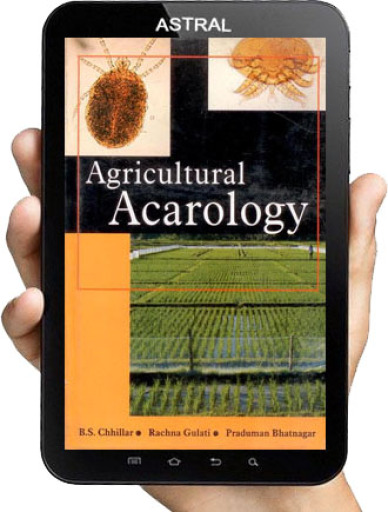
Agricultural Acarology
Por Rachna Gulati, Praduman Bhatnagar, B. S. Chhillar
Publicado por Astral International Pvt Ltd

English
405 páginas
2021
ISBN 9789383129072
PDF
Sobre este libro
Acarines are prominent pests of field crops, granaries, warehouse and animals (arthropods, birds) causing heavy financial losses. House dust acarines are notorious agents of allergic reactions in human beings and other mammals. Acarines because of their small size and cryptic habitat are difficult to detect and hence most of the time infestations are overlooked. Once established in a new area, certain biological characteristics like high fecundity, various modes of reproduction, short life cycles, a myriad of dispersal techniques and adaptability to diverse ecological conditions allow rapid escalation to pest status. On the other hand, acarines are among the major resources for biological control of various classes of pests including insects, nematodes and weeds. These widely distributed microscopic animal ranging from free living to parasitic forms and terrestrial to aquatic forms require specialized techniques for handling. The literature regarding their biodiversity, collection, rearing, biology etc. are scattered and most of the time unavailable to scientists interested to work on them. Hence, a comprehensive book on agricultural acarology is prepared which covers all aspects of acarine biodiversity, acarological techinques and their role as bio-control agent in an abridged form. The book is divided into three sections-’Acarine biodiversity’, Acarological techniques’ and ‘Acarines as biocontrol agents’. Acarine biodiversity contains six chapters, one each on plant, stored, soil, house dust, parasitic and water mites. In second section, details on techniques of collection and extraction, preparation and mounting, labelling and housing the collection, culturing, counting and bioassay are given in individual chapters. Information related to predatory potential of acarines against insects, nematodes and weeds is included in third section in three chapters. The book has been liberally furnished with illustrations for better understanding. An extensive list of references and glossary are also provided at the ende of the book.
Categorías
- Idioma
- English
Compartir
También te puede interesar
Current Trends in Farming Systems Research
Mehta, A K et al
Agriculture for Competitive Examinations-IFS
B.B. Singh
Voluntary Agencies and Rural Development
Seema Nikalje
Organic Farming
A V Ramanjaneyulu, K A Gopinath
Technology Transfer and Small & Medium Enterprises in Developing Countries/NAM S&T Centre
K. Ramanathan, Keith. Jacobs, M. Bandyopadhayay
Sugarcane Production: Advance Techniques
Lalita Rana, Anil Kumar, Manish Kumar, Navnit Kumar, Sudhanandini, Anil Kumar Singh