
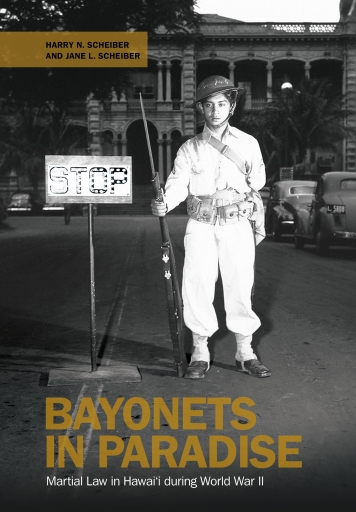
Bayonets in Paradise
Por Scheiber, Harry N., Scheiber, Jane L.
Publicado por University of Hawaii Press
English
2016
ISBN 9780824852900
Disponible en 0 librerías
Todavía no disponible en ninguna tienda.
Sobre este libro
<p><b>Selected as a 2017 <i>CHOICE </i>Outstanding Academic Title</b><i><br><br>Bayonets in Paradise</i> recounts the extraordinary story of how the army imposed rigid and absolute control on the total population of Hawaii during World War II. Declared immediately after the Pearl Harbor attack, martial law was all-inclusive, bringing under army rule every aspect of the Territory of Hawaii's laws and governmental institutions. Even the judiciary was placed under direct subservience to the military authorities. The result was a protracted crisis in civil liberties, as the army subjected more than 400,000 civilians—citizens and alien residents alike—to sweeping, intrusive social and economic regulations and to enforcement of army orders in provost courts with no semblance of due process. In addition, the army enforced special regulations against Hawaii's large population of Japanese ancestry; thousands of Japanese Americans were investigated, hundreds were arrested, and some 2,000 were incarcerated. In marked contrast to the well-known policy of the mass removals on the West Coast, however, Hawaii's policy was one of "selective," albeit preventive, detention.<br><br>Army rule in Hawaii lasted until late 1944—making it the longest period in which an American civilian population has ever been governed under martial law. The army brass invoked the imperatives of security and "military necessity" to perpetuate its regime of censorship, curfews, forced work assignments, and arbitrary "justice" in the military courts. Broadly accepted at first, these policies led in time to dramatic clashes over the wisdom and constitutionality of martial law, involving the president, his top Cabinet officials, and the military. The authors also provide a rich analysis of the legal challenges to martial law that culminated in <i>Duncan v. Kahanamoku,</i> a remarkable case in which the U.S. Supreme Court finally heard argument on the martial law regime—and ruled in 1946 that provost court justice and the military's usurpation of the civilian government had been illegal.<br><br>Based largely on archival sources, this comprehensive, authoritative study places the long-neglected and largely unknown history of martial law in Hawaii in the larger context of America's ongoing struggle between the defense of constitutional liberties and the exercise of emergency powers.</p>
- Idioma
- English
Compartir
También te puede interesar
Los médicos de Hitler
Moros Peña, Manuel
Desarmamento na França ocupada pelos nazistas (Digital)
P. Halbrook, Stephen
Inclusion
Coffman, Tom

Kampfschwimmer der Kriegsmarine - Lehrkommando 700
Lewandowski, Walter
Berlín
Beevor, Antony

Als U-Boots-Kommandant gegen England
Forstner, Freiherr von Georg-Günther