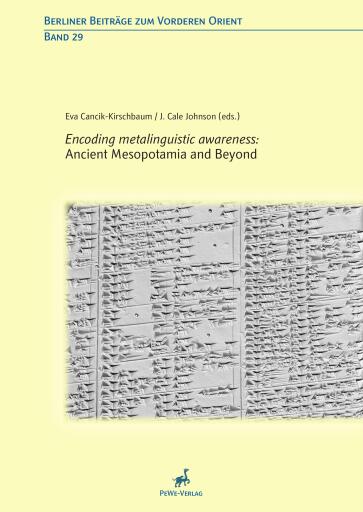
Encoding Metalinguistic Awareness
Publicado por PeWe-Verlag
English
227 páginas
2019
ISBN 9783689850210
Tiempo de lectura estimado: 4 h 10 min
PDF
Buy at Viubux
🇲🇽
 Alpha Books
🇨🇴
Visitar tienda →
Alpha Books
🇨🇴
Visitar tienda →
 Bajalibros Argentina
🇦🇷
Visitar tienda →
Bajalibros Argentina
🇦🇷
Visitar tienda →
 Bajalibros Latam
🇺🇸
Visitar tienda →
Bajalibros Latam
🇺🇸
Visitar tienda →
 Bookshop Uruguay
🇺🇾
Visitar tienda →
Bookshop Uruguay
🇺🇾
Visitar tienda →
 Crisol Ebooks
🇵🇪
Visitar tienda →
Crisol Ebooks
🇵🇪
Visitar tienda →
Disponible en 13 librerías
Alpha Books
🇨🇴
Visitar tienda →
Bajalibros Argentina
🇦🇷
Visitar tienda →
Bajalibros Latam
🇺🇸
Visitar tienda →
Bookshop Uruguay
🇺🇾
Visitar tienda →
Crisol Ebooks
🇵🇪
Visitar tienda →








Sobre este libro
The Ancient Near East provides a particularly striking example for the dynamics of knowledge transfer throughout space and time. The civilizations that emerged here, at the dawn of history, attest to continuous processes of exchange, adaption, and negotiation, to the emergence of content and its reconfiguration, to diffusion, disappearance and resurgence of themes, concepts, topics and ideas. In the late fourth millennium the creation and implementation of supraregional notational systems in southern Mesopotamia triggers a cognitive revolution: within a few centuries the use of writing becomes a dominant cultural technique and over the subsequent millennia the technique of wedge-writing spreads throughout southwest Asia. Numerous indigenous cuneiform subcultures came into being in a wide variety of times and places, but these distinct instantiations were held together (and preserved the possibility of common legibility) through shared practices of teaching and learning, a common core of textual materials and, not least, a systematic instrumentarium for representing speech and notation. This repertoire is part of each of these streams of tradition, which characterise the cuneiform cultures as a whole. In light of the centuries of tradition, the great effort that has gone into its construction and maintenance as well as the preservation of original linguistic materials and their translation into more familiar languages, the validity of this scientific tradition, broadly conceived, cannot be disputed. Still, even if the historical processes of transmission within the cuneiform world and the difficulties of translating cuneiform sources into non-cuneiform traditions prevented a general and far-reaching mobilisation of the cuneiform sources as vehicles for scientific reflection, these same factors also ensured its continued survival in Mesopotamia and Syria for not centuries, but rather millennia. One of the most important components of this process was the awareness of practitioners about language, its role for and its impact on the generation of knowledge, and specifically about linguistic patterns. Among the literally innumerable textual artefacts from the ancient Near East, there are some that both explicitly and implicitly encode traces of this distinctively linguistic awareness. It was in pursuit of these traces of (meta)linguistic awareness that the participants in this volume came together.
Disponibilidad
Encoding Metalinguistic Awareness está disponible como PDF en 13 librerías online. Entre las librerías que lo venden están Alpha Books, Bajalibros Argentina, Bajalibros Latam.
Categorías
- Idioma
- English
Compartir
Preguntas frecuentes
- ¿En qué formatos está disponible Encoding Metalinguistic Awareness?
- Encoding Metalinguistic Awareness está disponible como PDF en 13 librerías online.
- ¿Dónde puedo comprar Encoding Metalinguistic Awareness?
- Puedes comprar Encoding Metalinguistic Awareness en Alpha Books, Bajalibros Argentina, Bajalibros Latam. Compara todas las opciones en la lista de esta página.
- ¿Cuánto se tarda en leer Encoding Metalinguistic Awareness?
- A un ritmo de lectura medio, Encoding Metalinguistic Awareness se lee en unas 4 h 10 min (227 páginas).
Valoraciones y reseñas
Aún no hay valoraciones. Sé el primero en reseñar este libro.
Acceder para valorar y reseñar este libro.