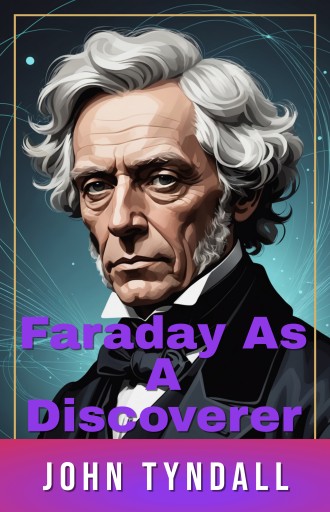
Faraday As A Discoverer
Por Tyndall, John
Publicado por E-Kitap Projesi & Cheapest Books
English
2024
ISBN 9786059654173
eBook
Buy at Bajalibros Latam
🇺🇸
Bajalibros Latam
🇺🇸
Visitar tienda →
LORANCHBOOKSTORE
🇺🇸
Visitar tienda →
Libros Patagonia
🇨🇱
Visitar tienda →
Ebooks Librería Carlos Fuentes
🇲🇽
Visitar tienda →
Ebooks Librería Antártica
🇨🇱
Visitar tienda →
Ebooks Happy Books
🇨🇴
Visitar tienda →
ebooks libreria española
🇪🇨
Visitar tienda →
Bajalibros Argentina
🇦🇷
Visitar tienda →
Alpha Books
🇨🇴
Visitar tienda →

Sanborns Ebooks
🇲🇽
Visitar tienda →
ebooks Libreria del GAM
🇨🇱
Visitar tienda →
Bookshop Uruguay
🇺🇾
Visitar tienda →
Ebooks Yenny - El Ateneo
🇦🇷
Visitar tienda →
Crisol Ebooks
🇵🇪
Visitar tienda →
Disponible en 14 librerías
LORANCHBOOKSTORE
🇺🇸
Visitar tienda →
Libros Patagonia
🇨🇱
Visitar tienda →
Ebooks Librería Carlos Fuentes
🇲🇽
Visitar tienda →
Ebooks Librería Antártica
🇨🇱
Visitar tienda →
Ebooks Happy Books
🇨🇴
Visitar tienda →
ebooks libreria española
🇪🇨
Visitar tienda →
Alpha Books
🇨🇴
Visitar tienda →
Sanborns Ebooks
🇲🇽
Visitar tienda →
ebooks Libreria del GAM
🇨🇱
Visitar tienda →
Ebooks Yenny - El Ateneo
🇦🇷
Visitar tienda →
Crisol Ebooks
🇵🇪
Visitar tienda →
Sobre este libro
Michael Faraday (1791 –1867) was an English scientist who contributed to the fields of electromagnetism and electrochemistry. His main discoveries include those of electromagnetic induction, diamagnetism and electrolysis.
Although Faraday received little formal education, he was one of the most influential scientists in history. It was by his research on the magnetic field around a conductor carrying a direct current that Faraday established the basis for the concept of the electromagnetic field in physics. Faraday also established that magnetism could affect rays of light and that there was an underlying relationship between the two phenomena. He similarly discovered the principle of electromagnetic induction, diamagnetism, and the laws of electrolysis. His inventions of electromagnetic rotary devices formed the foundation of electric motor technology, and it was largely due to his efforts that electricity became practical for use in technology.
As a chemist, Faraday discovered benzene, investigated the clathrate hydrate of chlorine, invented an early form of the Bunsen burner and the system ofoxidation numbers, and popularised terminology such as anode, cathode, electrode, and ion. Faraday ultimately became the first and foremost Fullerian Professor of Chemistry at the Royal Institution of Great Britain, a life-time position..
Faraday was an excellent experimentalist who conveyed his ideas in clear and simple language; his mathematical abilities, however, did not extend as far as trigonometry or any but the simplest algebra. James Clerk Maxwell took the work of Faraday and others, and summarized it in a set of equations that is accepted as the basis of all modern theories of electromagnetic phenomena. On Faraday's uses of the lines of force, Maxwell wrote that they show Faraday "to have been in reality a mathematician of a very high order – one from whom the mathematicians of the future may derive valuable and fertile methods." The SI unit of capacitance is named in his honour: the farad.
Albert Einstein kept a picture of Faraday on his study wall, alongside pictures of Isaac Newton and James Clerk Maxwell. Physicist Ernest Rutherford stated; "When we consider the magnitude and extent of his discoveries and their influence on the progress of science and of industry, there is no honour too great to pay to the memory of Faraday, one of the greatest scientific discoverers of all time".
Categorías
- Idioma
- English
Compartir
También te puede interesar
Half Hours With Modern Scientists
Huxley, Thomas Henry, Stirling, James Hutchison, Barker, George F., Cope, E. D., Tyndall, John
50 REJECTIONS THAT SHAPED HISTORY
Heggings , Steven
Con luz propia. Vencer en tiempos de incertidumbre
Obama, Michelle
Através Da Sua Lente
Sousa, Wanessa
Catherine, principessa di Galles
Jobson Robert
Cheia de graça
Périssé, Heloisa, Pessoa, Isa