Ir al contenido principal
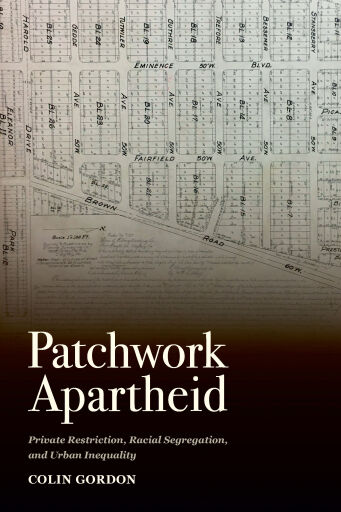
Patchwork Apartheid

Patchwork Apartheid

Por Gordon, Colin

Publicado por Russell Sage Foundation

English 2023 ISBN 9781610449229
eBook

Sobre este libro

For the first half of the twentieth century, private agreements to impose racial restrictions on who could occupy property decisively shaped the development of American cities and the distribution of people within them. Racial restrictions on the right to buy, sell, or occupy property also effectively truncated the political, social, and economic citizenship of those targeted for exclusion. In Patchwork Apartheid, historian Colin Gordon examines the history of such restrictions and how their consequences reverberate today. Drawing on a unique record of property restrictions excavated from local property records in five Midwestern counties, Gordon documents the prevalence of private property restriction in the era before zoning and building codes were widely employed and before federal redlining sanctioned the segregation of American cities and suburbs. This record of private restriction—documented and mapped to the parcel level in Greater Minneapolis, Greater St. Louis, and two Iowa counties—reveals the racial segregation process both on the ground, in the strategic deployment of restrictions throughout transitional central city neighborhoods and suburbs, and in the broader social and legal construction of racial categories and racial boundaries.   Gordon also explores the role of other policies and practices in sustaining segregation. Enforcement of private racial restrictions was held unconstitutional in 1948, and such agreements were prohibited outright in 1968. But their premises and assumptions, and the segregation they had accomplished, were accommodated by local zoning and federal housing policies. Explicit racial restrictions were replaced by the deceptive business practices of real estate agents and developers, who characterized certain neighborhoods as white and desirable and others as black and undesirable, thereby hiding segregation behind the promotion of sound property investments, safe neighborhoods, and good schools. These practices were in turn replaced by local zoning, which systematically protected white neighborhoods while targeting “blighted” black neighborhoods for commercial and industrial redevelopment, and by a tangle of federal policies that reliably deferred to local and private interests with deep investments in local segregation. Private race restriction was thus a key element in the original segregation of American cities and a source of durable inequalities in housing wealth, housing opportunity, and economic mobility. Patchwork Apartheid exhaustively documents the history of private restriction in urban settings and demonstrates its crucial role in the ideas and assumptions that have sustained racial segregation in the United States into the twenty-first century.

Disponibilidad

Patchwork Apartheid está disponible como eBook en 13 librerías online. Entre las librerías que lo venden están Association of University Presses - Tienda FILUNI, Bajalibros Argentina, Bajalibros Latam.

Idioma
English
Compartir

Preguntas frecuentes

¿En qué formatos está disponible Patchwork Apartheid?
Patchwork Apartheid está disponible como eBook en 13 librerías online.
¿Dónde puedo comprar Patchwork Apartheid?
Puedes comprar Patchwork Apartheid en Association of University Presses - Tienda FILUNI, Bajalibros Argentina, Bajalibros Latam. Compara todas las opciones en la lista de esta página.

Valoraciones y reseñas

Aún no hay valoraciones. Sé el primero en reseñar este libro.

Acceder para valorar y reseñar este libro.

Comentarios

Acceder para unirte a la conversación.

Aún no hay comentarios.