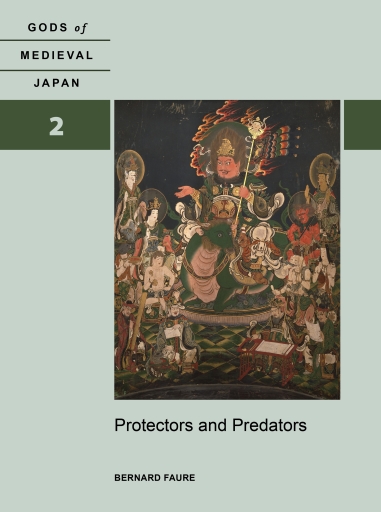
Protectors and Predators
Por Faure, Bernard
Publicado por University of Hawaii Press
English
514 páginas
2015
ISBN 9780824857721
PDF
Buy at Bajalibros Latam
🇺🇸
Catademic
🇺🇸
Visitar tienda →
Bajalibros Latam
🇺🇸
Visitar tienda →
Disponible en 8 librerías
Catademic
🇺🇸
Visitar tienda →
Sobre este libro
<p>Written by one of the leading scholars of Japanese religion, <i>Protectors and Predators</i> is the second installment of a multivolume project that promises to be a milestone in our understanding of the mythico-ritual system of esoteric Buddhism—specifically the nature and roles of deities in the religious world of medieval Japan and beyond. Bernard Faure introduces readers to medieval Japanese religiosity and shows the centrality of the gods in religious discourse and ritual. Throughout he engages theoretical insights drawn from structuralism, post-structuralism, and Actor-Network Theory to retrieve the “implicit pantheon” (as opposed to the “explicit orthodox pantheon”) of esoteric Japanese Buddhism (Mikkyō). His work is particularly significant given its focus on the deities’ multiple and shifting representations, overlappings, and modes of actions rather than on individual characters and functions.<br><br>In <i>Protectors and Predators</i> Faure argues that the “wild” gods of Japan were at the center of the medieval religious landscape and came together in complex webs of association not divisible into the categories of “Buddhist,” “indigenous,” or “Shinto.” Furthermore, among the most important medieval gods, certain ones had roots in Hinduism, others in Daoism and Yin-Yang thought. He displays vast knowledge of his subject and presents his research—much of it in largely unstudied material—with theoretical sophistication. His arguments and analyses assume the centrality of the iconographic record as a complement to the textual record, and so he has brought together a rich and rare collection of more than 170 color and black-and-white images. This emphasis on iconography and the ways in which it complements, supplements, or deconstructs textual orthodoxy is critical to a fuller comprehension of a set of medieval Japanese beliefs and practices and offers a corrective to the traditional division of the field into religious studies, which typically ignores the images, and art history, which oftentimes overlooks their ritual and religious meaning.<br><br><i>Protectors and Predators</i> and its companion volumes should persuade readers that the gods constituted a central part of medieval Japanese religion and that the latter cannot be reduced to a simplistic confrontation, parallelism, or complementarity between some monolithic teachings known as “Buddhism” and “Shinto.” Once these reductionist labels and categories are discarded, a new and fascinating religious landscape begins to unfold.</p>
Categorías
- Idioma
- English
Compartir
También te puede interesar
Uniformes Da Segunda Guerra Mundial
Ygua, Ruben
Marathon Japan
Havens, Thomas R. H.
The Art of Persistence
Eubanks, Charlotte
Unspeakable Acts
Sorgenfrei, Carol Fisher
Shimaji Mokurai and the Reconception of Religion and the Secular in Modern Japan
Krämer, Hans Martin
A Year in Seventeenth-Century Kyoto
Groemer, Gerald