Ir al contenido principal
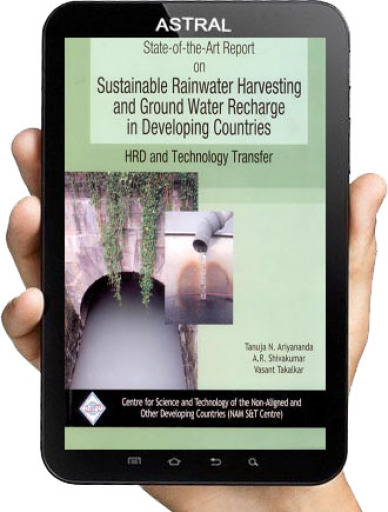
Sustainable Rainwater Harvesting and Groundwater Recharge in Developing Countires/NAM S&T Cen

Sustainable Rainwater Harvesting and Groundwater Recharge in Developing Countires/NAM S&T Cen

Por A. R. Shivakumar, Vasant Takalkar, Tanuja N. Ariyananda

Publicado por Astral International Pvt Ltd

English 758 páginas 2021 ISBN 9789351301752
Tiempo de lectura estimado: 13 h 54 min
PDF

Sobre este libro

Rainwater harvesting is a technique for accumulating and storing of rainwater channelised to flow to the ponds, lakes and over- and underground storage places, which can be used not only to recharge the groundwater, but also to provide drinking water, for irrigation, livestock as well as other typical uses given to water. The rainwater is collected from various hard surfaces such as roof tops and/or other types of manmade above ground hard surfaces. Rainwater harvesting also aids in keeping the village roads from getting slushy during the rains and maintaining the transport mobility mobility and prevent flooding in some urban areas. The Centre for Science and Technology of the Non-Aligned and Other Developing Countries (NAM S&T Centre) implemented a multilateral collaborative project on ‘Sustainable Rainwater Harvesting and Ground Water Recharge in Developing Countries - HRD and Technology Transfer’ which was partially supported by the Group of 77 (G77) under its Perez-Guerrero Trust Fund PGTF). The three year project was an integrated effort on Rainwater Harvesting (RWH) and Ground Water Recharge (GWR) as a model solution to solve the water shortage problem in conventional water supply systems in the developing countries. The prime objective of the Project was capacity building through HRD and technology transfer by executing two major components, viz. preparing a State-of-the-Art Report to help professionals in planning and modifying water conservation and supply schemes, and holding a centralised Training Programme for professionals from developing countries engaged in implementing relevant schemes to empower them to organize national level training courses for water technicians This Publication is based on the material and country status papers compiled to prepare the State-of-the-Art Report as indicated above, and includes four sections. Section-I contains the introductory articles and some relevant photographs; Section-II is the major portion of the publication that reveals the status of 17 developing countries on RWH and GWR practices, successful models and case studies; Section-III gives information exclusively on RWH & GWR practices in Rural Areas through a manual; and Section-IV comprises two important parts viz., ‘Trainers Manual’ to help professionals with its detailed technical specifications on drawings, designs and mechanisms of urban RWH & GWR systems and the RWH Guide for common people to learn and implement simple models on their own. The book has been jointly edited by Dr. Tanuja N. Ariyananda, Director, Lanka Rainwater Harvesting Forum, Sri Lanka; Mr. Vasant Takalkar IFS, Consultant, Maharashtra Knowledge Corporation Ltd. (MKCL) Pune, India. Mr. A.R. Shivakumar, Principal Investigator, RWH, Karnataka State Council for Science and Technology (KSCST), Bangalore, India. It is hoped that this publication would be a useful resource material for the engineers, researchers, experts and practitioners interested in water management in

Disponibilidad

Sustainable Rainwater Harvesting and Groundwater Recharge in Developing Countires/NAM S&T Cen está disponible como PDF en 1 librería online.

Idioma
English
Compartir

Preguntas frecuentes

¿En qué formatos está disponible Sustainable Rainwater Harvesting and Groundwater Recharge in Developing Countires/NAM S&T Cen?
Sustainable Rainwater Harvesting and Groundwater Recharge in Developing Countires/NAM S&T Cen está disponible como PDF en 1 librería online.
¿Dónde puedo comprar Sustainable Rainwater Harvesting and Groundwater Recharge in Developing Countires/NAM S&T Cen?
Puedes comprar Sustainable Rainwater Harvesting and Groundwater Recharge in Developing Countires/NAM S&T Cen en Catademic. Compara todas las opciones en la lista de esta página.
¿Cuánto se tarda en leer Sustainable Rainwater Harvesting and Groundwater Recharge in Developing Countires/NAM S&T Cen?
A un ritmo de lectura medio, Sustainable Rainwater Harvesting and Groundwater Recharge in Developing Countires/NAM S&T Cen se lee en unas 13 h 54 min (758 páginas).

Valoraciones y reseñas

Aún no hay valoraciones. Sé el primero en reseñar este libro.

Acceder para valorar y reseñar este libro.

Comentarios

Acceder para unirte a la conversación.

Aún no hay comentarios.