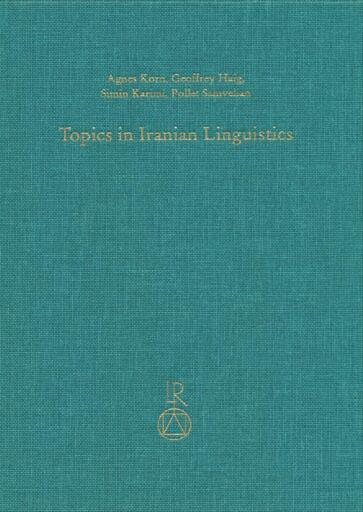
Topics in Iranian Linguistics
Publicado por Dr Ludwig Reichert Verlag
English
225 páginas
2010
Tiempo de lectura estimado: 4 h 8 min
PDF
Buy at Ebooks Yenny - El Ateneo
🇦🇷
 Bajalibros Argentina
🇦🇷
Visitar tienda →
Bajalibros Argentina
🇦🇷
Visitar tienda →
 Bajalibros Latam
🇺🇸
Visitar tienda →
Bajalibros Latam
🇺🇸
Visitar tienda →
 Bookshop Uruguay
🇺🇾
Visitar tienda →
Bookshop Uruguay
🇺🇾
Visitar tienda →
 Crisol Ebooks
🇵🇪
Visitar tienda →
Crisol Ebooks
🇵🇪
Visitar tienda →
 ebooks Libreria del GAM
🇨🇱
Visitar tienda →
ebooks Libreria del GAM
🇨🇱
Visitar tienda →
Disponible en 7 librerías
Bajalibros Argentina
🇦🇷
Visitar tienda →
Bajalibros Latam
🇺🇸
Visitar tienda →
Bookshop Uruguay
🇺🇾
Visitar tienda →
Crisol Ebooks
🇵🇪
Visitar tienda →
ebooks Libreria del GAM
🇨🇱
Visitar tienda →


Sobre este libro
Up until quite recently, research on Iranian languages tended to be conducted in rather distinct disciplines, often with little interaction among them. A major turning point in bringing scholars from all theoretical persuasions together was the "First International Conference on Iranian Linguistics", held in June 2005 at the Max Planck Institute for Evolutionary Anthropology in Leipzig. It inaugurated a tradition of interdisciplinary linguistic research on Iranian languages that we are proud to continue with the present volume.
The 13 chapters of this volume represent a selection of the papers presented at the "Third International Conference on Iranian Linguistics", held in September 2009 at the Université Sorbonne Nouvelle in Paris. Part one, historical and comparative Iranian syntax, contains chapters by Saloumeh Gholami, Nicholas Sims-Williams, Antje Wendtland, Agnes Korn, and Arseniy Vydrin. The first three contributions treat the morpho-syntax of two extinct East Iranian languages, revealing a fruitful and innovative synthesis of philological investigations with insights from syntactic typology. Korn's chapter covers both synchronic and diachronic aspects of a typologically unusual development in a broad range of Iranian languages, while Vydrin's chapter surveys the expression of counterfactuality within Iranian from a largely synchronic perspective, but informed with areal-typological explanations. Part two, the morpho-syntax of lesser-know Iranian languages, contains contributions by Daniel Paul, Gregory Stump and Andrew Hippisley, and two joint contributions, Oleg Belaev and Arseniy Vydrin, and David Erschler and Vitaly Volk. They reflect a growing interest in the "smaller" Iranian languages, not only as a source for comparative and historical Iranian philology, but also for the insights they offer for general linguistic theory. Part three, the linguistics of Modern Persian, presents new insights on aspects of Modern Persian. Naderi and Oostendorp's contribution presents an OT-based re-assessment of epenthetic consonants, while Ganjavi revisits the issue of marking vs. non-marking of direct objects. Pirooz looks at control in finite subordinate clauses, while Deravi and Dommergues present the results of an empirical investigation of code-switching by highly proficient Persian-French bilinguals.
Taken together, these contributions represent the dynamic and rapidly growing nature of Iranian linguistics, a field which has united linguists of all persuasions who share a strong commitment to the scientific investigation of Iranian languages, their structure, history and use.
Disponibilidad
Topics in Iranian Linguistics está disponible como PDF en 7 librerías online. Entre las librerías que lo venden están Bajalibros Argentina, Bajalibros Latam, Bookshop Uruguay.
Categorías
- Idioma
- English
Compartir
Preguntas frecuentes
- ¿En qué formatos está disponible Topics in Iranian Linguistics?
- Topics in Iranian Linguistics está disponible como PDF en 7 librerías online.
- ¿Dónde puedo comprar Topics in Iranian Linguistics?
- Puedes comprar Topics in Iranian Linguistics en Bajalibros Argentina, Bajalibros Latam, Bookshop Uruguay. Compara todas las opciones en la lista de esta página.
- ¿Cuánto se tarda en leer Topics in Iranian Linguistics?
- A un ritmo de lectura medio, Topics in Iranian Linguistics se lee en unas 4 h 8 min (225 páginas).
Valoraciones y reseñas
Aún no hay valoraciones. Sé el primero en reseñar este libro.
Acceder para valorar y reseñar este libro.