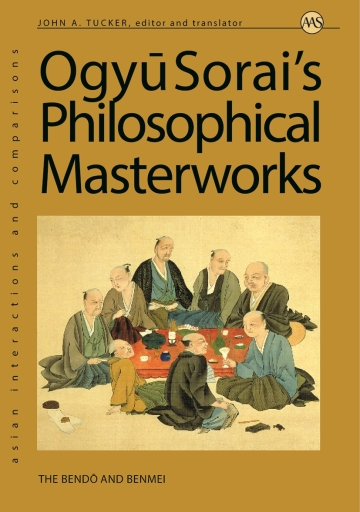
Ogyu Sorai's Philosophical Masterworks
Pubblicato da University of Hawaii Press
English
496 pagine
2006
ISBN 9780824841386
Tempo di lettura stimato: 9 h 6 min
PDF
Buy at ebookskitapenas
🇬🇹
 Association of University Presses - Tienda FILUNI
🇺🇸
Visita il negozio →
Association of University Presses - Tienda FILUNI
🇺🇸
Visita il negozio →
 Bajalibros Argentina
🇦🇷
Visita il negozio →
Bajalibros Argentina
🇦🇷
Visita il negozio →
 Bajalibros Latam
🇺🇸
Visita il negozio →
Bajalibros Latam
🇺🇸
Visita il negozio →
 Bookshop Uruguay
🇺🇾
Visita il negozio →
Bookshop Uruguay
🇺🇾
Visita il negozio →
 Catademic
🇺🇸
Visita il negozio →
Catademic
🇺🇸
Visita il negozio →
Disponibile in 13 librerie
Association of University Presses - Tienda FILUNI
🇺🇸
Visita il negozio →
Bajalibros Argentina
🇦🇷
Visita il negozio →
Bajalibros Latam
🇺🇸
Visita il negozio →
Bookshop Uruguay
🇺🇾
Visita il negozio →
Catademic
🇺🇸
Visita il negozio →








Informazioni su questo libro
Ogyû Sorai (1666–1728) was one of the greatest philosophers of early modern Japan. This volume, a monumental work of scholarship, offers for the first time in any Western language unabridged and fully annotated translations of Sorai’s masterpieces. The Bendô (Distinguishing the Way) and Benmei (Distinguishing Names) are works of political philosophy that define the theoretical foundation for a leadership exercising total power, the best remedy, in Sorai’s view, for a regime in crisis. The translations are based on the 1740 (Genbun 5) woodblock edition, the first major edition of these seminal texts published during the Tokugawa period.
In his commentary, John Tucker situates the Bendô and Benmei in relation to Neo-Confucianism via what is known as "philosophical lexicography." This genre, which links Sorai’s thinking with Neo-Confucianism, is traced to the early-thirteenth-century Song dynasty text the Xingli ziyi (The Meanings of Neo-Confucian Terms) by Chen Beixi (1159–1223). Although Sorai was an unrelenting critic the Neo-Confucian formulations of the great Song synthesizer Zhu Xi (1130–1200), his thinking remained, due to its genre, methodology, and conceptual repertory, essentially a radical revision of Neo-Confucian discourse. Tucker’s introduction also examines the reception of Sorai’s two Ben during the remainder of the Tokugawa, calling attention to radical tendencies in later developments of Sorai’s thought as well as to the increasingly scathing critiques of his "Chinese" approach to philosophy, language, and politics. Finally, it traces the vicissitudes of the two Ben in modern Japanese intellectual history and their role in the formation of the ideas of Meiji intellectuals such as Nishi Amane (1829–1897) and Kato Hiroyuki (1836–1916).
As before, however, Sorai came under attack—this time for his supposed irreverence toward the throne, the Japanese people, and the imperial nation-state. Though an unpopular philosophy in early twentieth-century Japan, in the postwar years Sorai’s thought was interpreted (by Maruyama Masao and others) as an important modernizing force. While it critiques such ideologically grounded attempts to cast Sorai’s Bendô and Benmei as theoretical contributions to political modernization, Tucker’s study nevertheless acknowledges that Sorai’s masterworks, in their concern for language analysis as the way to solve philosophical problems, share significant common ground with the analytic approach to philosophy pioneered by various twentieth-century Anglo-American philosophers.
Disponibilità
Ogyu Sorai's Philosophical Masterworks è disponibile come PDF in 13 librerie online. Tra le librerie che lo vendono ci sono Association of University Presses - Tienda FILUNI, Bajalibros Argentina, Bajalibros Latam.
- Lingua
- English
Condividi
Domande frequenti
- In quali formati è disponibile Ogyu Sorai's Philosophical Masterworks?
- Ogyu Sorai's Philosophical Masterworks è disponibile come PDF in 13 librerie online.
- Dove posso comprare Ogyu Sorai's Philosophical Masterworks?
- Puoi comprare Ogyu Sorai's Philosophical Masterworks su Association of University Presses - Tienda FILUNI, Bajalibros Argentina, Bajalibros Latam. Confronta tutte le opzioni nell’elenco di questa pagina.
- Quanto tempo ci vuole per leggere Ogyu Sorai's Philosophical Masterworks?
- A un ritmo di lettura medio, Ogyu Sorai's Philosophical Masterworks si legge in circa 9 h 6 min (496 pagine).
Valutazioni e recensioni
Ancora nessuna valutazione. Sii il primo a recensire questo libro.
Accedi per valutare e recensire questo libro.