Ir para o conteúdo principal
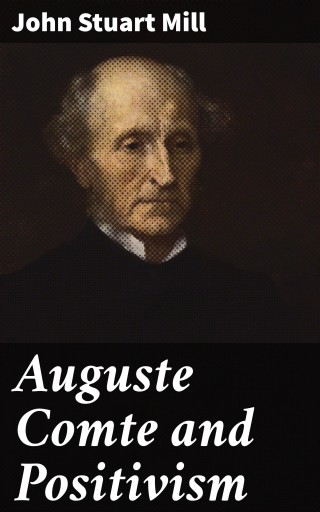
Auguste Comte and Positivism

Auguste Comte and Positivism

Por Mill, John Stuart

Publicado por Good Press

English 2023 ISBN 8596547523147
eBook

Sobre este livro

In "Auguste Comte and Positivism," John Stuart Mill offers a comprehensive examination of the philosophical framework proposed by Auguste Comte, the father of positivism. Mill's text is marked by a critical yet appreciative tone, demonstrating his engagement with Comte's ideas on science and society. He navigates through the intricacies of positivism, elucidating its core tenets while also addressing its implications for epistemology and ethical thought. This work is situated in the broader context of 19th-century Enlightenment ideals, reflecting Mill's commitment to empiricism and rationality while simultaneously grappling with the limitations of Comte's systematic approach to understanding social phenomena. John Stuart Mill, a prominent figure in classical liberalism, was heavily influenced by the intellectual milieu of his time, including the works of Jeremy Bentham and the evolution of scientific reasoning. His keen interest in social reform, derived from his background and personal experiences within a utilitarian household, guided his exploration of Comte'Äôs ideas. Mill'Äôs philosophical background and his advocacy for liberty and individuality informed his perspective on positivism, as he sought to reconcile scientific inquiry with ethical considerations. "Auguste Comte and Positivism" is a must-read for scholars and students alike who seek to understand the interplay between science, philosophy, and sociology. Mill'Äôs critical analysis not only enriches our comprehension of positivism but also offers valuable insights into the perennial questions of knowledge, progress, and human values. This book provides a pivotal lens through which to examine the evolution of social thought and is essential for anyone interested in the foundations of modern philosophy.
Idioma
English
Compartilhar

Você também pode gostar

Filosofía de clase media

Filosofía de clase media

Fabregat, Federico

An apology for idlers, and other essays

An apology for idlers, and other essays

Stevenson, Robert Louis

50 Clásicos que debes leer antes de morir

50 Clásicos que debes leer antes de morir

Shakespeare, William, Alighieri, Dante, Twain, Mark, Woolf, Virginia, Stevenson, Robert Louis, von Goethe, Johann Wolfgang, Flaubert, Gustave, Boccaccio, Giovanni, London, Jack, Joyce, James, Northup, Solomon, Hardy, Thomas, Scott, Walter, Aristóteles, Machado, Antonio, de Espronceda, José, Mill, John Stuart, Ibáñez, Vicente Blasco, Gibran, Kahlil, Doyle, Arthur Conan, Swift, Jonathan, Austen, Jane, Dumas, Alexandre, Hugo, Victor, Freud, Sigmund, Nietzsche, Friedrich, Meyrink, Gustav, Cooper, James Fenimore, Hawthorne, Nathaniel, Goethe, Johann Wolfgang, Baudelaire, Charles, Irving, Washington, Stowe, Harriet Beecher, Verne Julio, Lovecraft, H. P., De Unamuno, Miguel, Nervo, Amado, de Larra, Mariano José, de Quevedo, Francisco, del Valle-Inclán, Ramón María, Lorca, Federico García, Galdós, Benito Pérez, Brontë, Anne, Collodi, C., Dostoïevski, Fedor Mikhaïlovitch, Pushkin, Alexander Sergeyevich

Harvard Classics: Complete 51-Volume Anthology

Harvard Classics: Complete 51-Volume Anthology

Shakespeare, William, Luther, Martin, Manzoni, Alessandro, Andersen, Hans Christian, Stevenson, Robert Louis, Goethe, Johann Wolfgang von, Lessing, Gotthold Ephraim, Thoreau, Henry David, Pascal, Blaise, Darwin, Charles, Ruskin, John, de Cervantes, Miguel, Browning, Robert, Descartes, René, Kant, Immanuel, Coleridge, Samuel Taylor, Racine, Jean, Burke, Edmund, Molière, De Quincey, Thomas, Smith, Adam, Franklin, Benjamin, Shelley, Percy Bysshe, Mill, John Stuart, Milton, John, Webster, John, Penn, William, Renan, Ernest, Kempis, Thomas à, Bacon, Francis, Tacitus, Locke, John, Lamb, Charles, Hippocrates, Malory, Thomas, Montaigne, Michel de, Harrison, William Henry, Faraday, Michael, Corneille, Pierre, Macaulay, Thomas Babington, Augustine, Saint, Raleigh, Walter, Byron, George Gordon, Addison, Joseph, Walton, Izaak, Garrick, David, Bigges, Walter, Burns, Robert, Pretty, Francis, Steele, Richard, Pasteur, Louis, Cellini, Benvenuto, Lister, Joseph, von Helmholtz, Hermann Ludwig Ferdinand, Drake, Francis, Haies, Edward, Paré, Ambroise, Neilson, William A., Swift, Jonathan, Homer, Grimm, Jacob, Grimm, Wilhelm, Rousseau, Jean-Jacques, Defoe, Daniel, Eurípides, Thackeray, William Makepeace, Voltaire, More, Thomas, Hume, David, Carlyle, Thomas, Emerson, Ralph Waldo, de la Barca, Pedro Calderón, Johnson, Samuel, Bunyan, John, Dekker, Thomas, Machiavelli, Niccolò, Aesop, Aeschylus, Aurelius, Marcus, Plato, Sophocles, Dante Alighieri, Holmes, Oliver Wendell, Hazlitt, William, Smith, Sydney, Dana, Richard Henry, Herodotus, Aristophanes, Plutarch, Epictetus, Goldsmith, Oliver, Virgil, Younger, Pliny the, Fletcher, John, Beaumont, Francis, Hunt, Leigh, Roper, William, Marlowe, Christopher, Browne, Thomas, Dryden, John, Poe, Edgar Alan, Sidney, Philip, Newcomb, Simon, Cowley, Abraham, Nichols, Philip, Geikie, Archibald, Woolman, John, Sainte-Beuve, Charles Augustin, Mazzini, Giuseppe, Sheridan, Brinsley, Lowell, James Russell, Jonson, Ben, Cicero, Marcus Tullius, Hobbes, Thomas, Massinger, Philip, von Schiller, Friedrich, Berkeley, George, Harvey, William, Froissart, Jean

The Essence of Hume's Philosophy

The Essence of Hume's Philosophy

Hume, David

Abstand von der Rhetorik

Abstand von der Rhetorik

Semsch, Klaus