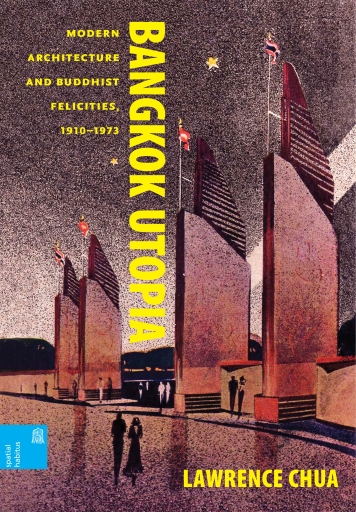
Bangkok Utopia
Por Chua, Lawrence
Publicado por University of Hawaii Press
English
2021
ISBN 9780824887742
eBook
Buy at Catademic
🇺🇸
Catademic
🇺🇸
Visitar loja →
Bajalibros Latam
🇺🇸
Visitar loja →
Disponível em 8 livrarias
Catademic
🇺🇸
Visitar loja →
About this book
<p>“Utopia” is a word not often associated with the city of Bangkok, which is better known for its disorderly sprawl, overburdened roads, and stifling levels of pollution. Yet as early as 1782, when the city was officially founded on the banks of the Chao Phraya river as the home of the Chakri dynasty, its orientation was based on material and rhetorical considerations that alluded to ideal times and spaces. The construction of palaces, monastic complexes, walls, forts, and canals created a defensive network while symbolically locating the terrestrial realm of the king within the Theravada Buddhist cosmos. Into the twentieth century, pictorial, narrative, and built representations of utopia were critical to Bangkok’s transformation into a national capital and commercial entrepôt. But as older representations of the universe encountered modern architecture, building technologies, and urban planning, new images of an ideal society attempted to reconcile urban-based understandings of Buddhist liberation and felicitous states like nirvana with worldly models of political community like the nation-state.<br><br><i>Bangkok Utopia</i> outlines an alternative genealogy of both utopia and modernism in a part of the world that has often been overlooked by researchers of both. It examines representations of utopia that developed in the city—as expressed in built forms as well as architectural drawings, building manuals, novels, poetry, and ecclesiastical murals—from its first general strike of migrant laborers in 1910 to the overthrow of the military dictatorship in 1973. Using Thai- and Chinese-language archival sources, the book demonstrates how the new spaces of the city became arenas for modern subject formation, utopian desires, political hegemony, and social unrest, arguing that the modern city was a space of antinomy—one able not only to sustain heterogeneous temporalities, but also to support conflicting world views within the urban landscape. <br><br>By underscoring the paradoxical character of utopias and their formal narrative expressions of both hope and hegemony, <i>Bangkok Utopia</i> provides an innovative way to conceptualize the uneven economic development and fractured political conditions of contemporary global cities.</p>
- Idioma
- English
Compartilhar
Você também pode gostar
O Dom da Mediunidade
Nobre, Marlene
Las guerras del Alto Karabaj - El decorado y su reverso
Lorgé, Jean-Marie
Uomini E Donne Dell'impero Romano
Ygua, Ruben
How France Built Her Cathedrals: A Study in the Twelfth and Thirteenth Centuries
O'Reilly, Elizabeth Boyle
St. Marien zu Rostock
Beyer, Franz-Heinrich
The Angel Roofs of East Anglia
Rimmer, Michael