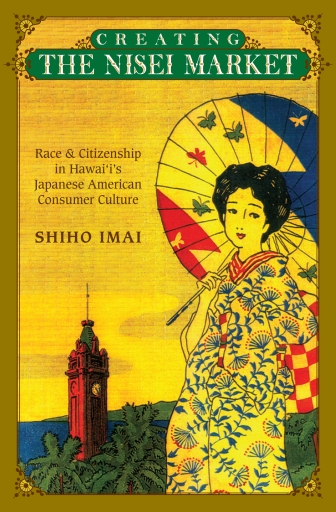
Creating the Nisei Market
Por Imai, Shiho
Publicado por University of Hawaii Press
English
233 páginas
2010
ISBN 9780824860431
PDF
Buy at Association of University Presses - Tienda FILUNI
🇺🇸
Catademic
🇺🇸
Visitar loja →
Bajalibros Latam
🇺🇸
Visitar loja →
Association of University Presses - Tienda FILUNI
🇺🇸
Visitar loja →

Ebooks Librería Antártica
🇨🇱
Visitar loja →
Ebooks Agustin
🇪🇸
Visitar loja →
Bajalibros Argentina
🇦🇷
Visitar loja →

Sanborns Ebooks
🇲🇽
Visitar loja →
ebooks Libreria del GAM
🇺🇾
Visitar loja →
Bookshop Uruguay
🇺🇾
Visitar loja →

ebookskitapenas
🇬🇹
Visitar loja →
Ebooks Yenny - El Ateneo
🇦🇷
Visitar loja →
Crisol Ebooks
🇨🇴
Visitar loja →
Disponível em 12 livrarias
Catademic
🇺🇸
Visitar loja →
Association of University Presses - Tienda FILUNI
🇺🇸
Visitar loja →
Ebooks Librería Antártica
🇨🇱
Visitar loja →
Ebooks Agustin
🇪🇸
Visitar loja →
Sanborns Ebooks
🇲🇽
Visitar loja →
ebooks Libreria del GAM
🇺🇾
Visitar loja →
ebookskitapenas
🇬🇹
Visitar loja →
Ebooks Yenny - El Ateneo
🇦🇷
Visitar loja →
Crisol Ebooks
🇨🇴
Visitar loja →
Sobre este livro
<p>In 1922 the U.S. Supreme Court declared Japanese immigrants ineligible for American citizenship because they were not "white," dismissing the plaintiff’s appeal to skin tone. Unable to claim whiteness through naturalization laws, Japanese Americans in Hawai‘i developed their own racial currency to secure a prominent place in the Island’s postwar social hierarchy. <i>Creating the Nisei Market</i> explores how different groups within Japanese American society (in particular the press and merchants) staked a claim to whiteness on the basis of hue and culture. Using Japanese- and English-language sources from the interwar years, it demonstrates how the meaning of whiteness evolved from mere physical distinctions to cultural markers of difference, increasingly articulated in material terms.<br><br>Nisei consumer culture demands examination because consumption was vital to the privilege-making process that spilled over into public life. Although economically motivated, Japanese American shopkeepers worked hard to support the next generation of merchants and secure the future of the Nisei consumer market. Far from its image as a static society, the Japanese American community was constantly reinventing itself to meet changing consumer demands and social expectations. The author builds on recent scholarship that considers ethnic communities within a trans-Pacific context, highlighting ethnic fluidity as a strategy for material and cultural success.<br><br>Yet even as it assumed a position of conformity, the Japanese American consumer culture that took hold among Honolulu’s middle class was distinct. It was at once modern and nostalgic, like the <i>wayo secchu</i> ideal—a hybrid of Western and Japanese notions of beauty and femininity that linked the ethnic group to the homeland and mainstream U.S. culture. By focusing on the marketing of whiteness that connected the old world and new, <i>Creating the Nisei Market</i> reveals the dynamic commercial and cultural environment that underwrote the rise of the Nisei in Hawai‘i.</p>
- Idioma
- English
Compartilhar
Você também pode gostar
As Cinco Leis Da Educação Financeira
Barboza, Victor Lavagnini
Inclusion
Coffman, Tom
Service-Geheimnis: Wie exzellenter Kundenservice dein Business transformiert
Hartmann, Leon
Información y atención al consumidor
Elgueta, Montserrat Cabrerizo
Decadência Woke
Denega, Marcos Antonio
É possível?
Campos, Marina