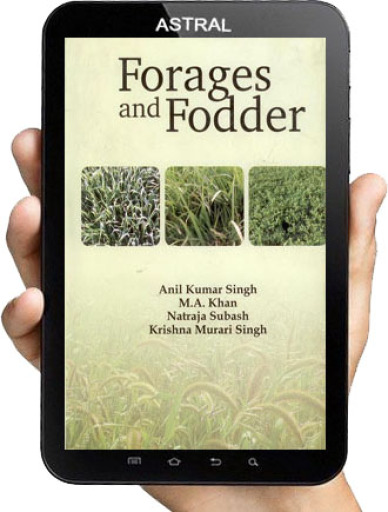
Forages and Fodder: Indian Perspective
Por Krishan Murari Singh, M A Khan, Natraj Subash, Anil Kumar Singh
Publicado por Astral International Pvt Ltd
English
629 páginas
2021
ISBN 9789383048090
PDF
Buy at Catademic
🇺🇸
Catademic
🇺🇸
Visitar loja →
AS
astralinternational
🇺🇸
Visitar loja →
Disponível em 2 livrarias
Catademic
🇺🇸
Visitar loja →
AS
astralinternational
🇺🇸
Visitar loja →
Sobre este livro
Book entitled “Forages and Fodder: Indian Perspective” contains different aspects viz., production, protection, PGR management, consumption; preservation and socio-economic aspects of forage and fodder crops. The present book is one of the latest and updated manuscripts related to forage and fodder in Indian context. Forage includes all plant species directly or indirectly consumed by animals and cultivated forage crops occupy about 5.0 per cent of the total cultivated area of India. The animal fodder consists of several plants species which are used to feed the cattle either raw (green and cut fodder) or after minor processing (such as silage) while pastures are grassland, usually with improved species, carefully managed with inputs such as irrigation and manures for grazing of livestock. The National Commission on Agriculture (1976) recommended that a minimum 10 per cent of the arable area in the country (about 16.5 million ha) should be under improved forage crops to meet the green forage needs of the ever growing livestock population. At the same time, plant genetic resource (PGR), which carries germplasm for present and future needs, can be utilized for producing varieties having resistance to biotic and abiotic stress as well as for its quality enrichments. Weed growth should not be overlooked as it hampers yield, lowers forage quality, increases the incidence of disease and insect problems, causes premature stand loss, and creates harvesting problems. Some weeds are unpalatable and may be poisonous for livestock. Updated information on insect pest problem is well documented in the book. It is established fact that insect and pests cause yield loss, both in quantitative and qualitative terms, and their effects depend on many factors like, the level of infestation, crop variety, agronomic practices and other related factors. Insect pests induced losses are not only in term of green or dry fodder yield but also on quality factors which affect the re-growth period and canopy structure. Among the other constraints, the diseases have always been a major limiting factor for fodder cultivation. Fertilizer management, organic farming and climatic conditions required for different fodder and forage crops are very well illustrated in the present volume. Women play a key role as seed selectors and in seedling production and their knowledge on seeds and seed storage contributes to viability of agricultural diversity and production. Women also play an important role in livestock management which includes, care of animals, grazing and fodder collection, cleaning of animal sheds, processing milk and livestock products. Despite their considerable involvement and contribution, women’s role in livestock production has been underestimated, undervalued and widely ignored. The book also covers areas like marketing of forage and fodders and all together contains 32 chapters on various issues of forage and fodder production and management.
Categorias
- Idioma
- English
Compartilhar
Você também pode gostar
Café
Díaz Arango, Félix Octavio
Biotechnology for Food Agriculture and Environment Vol 1
Devarajan Thangadurai, Annette Bennett, Tang Wei
Handbook of Library and Information Services (For Agriculture Science Students)
Rajkumar Singh
Medicinal Plants: Phytochemistry, Pharmacology and Therapeutics Vol. 1
Anpurna Kaul, G D Singh, Surjeet Singh, V K Gupta
Genetic Engineering Molecular Biology and Tissue Culture for Crop Pest and Disease Management
P Vidyashekharan
Major Constraints and Verdict of Crop Productivity in 2 Vols
U. N. Bhale