Ir para o conteúdo principal
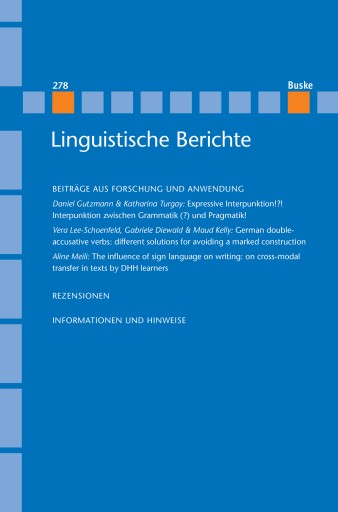
Linguistische Berichte Heft 278

Linguistische Berichte Heft 278

Publicado por Helmut Buske Verlag

German 123 páginas 2024 ISBN 9783967693973
Tempo de leitura estimado: 2 h 15 min
PDF

Sobre este livro

Beiträge aus Forschung und Anwendung – Daniel Gutzmann & Katharina Turgay: Expressive Interpunktion!?! Interpunktion zwischen Grammatik (?) und Pragmatik! Abstract: Whereas the use of most punctuation marks is thought to be governed by grammatical rules, some punctuation marks can be used in a more expressive way that rather reflects emotions and/or attitudes of the writer instead of grammatical properties. In this paper, we will discuss the distinction between grammatical and expressive punctuation and suggest that pragmatic punctuation marks exhibit certain features that the more grammatical punctuation marks do not: They are expressive, they can occur rather freely inside a sentence, they can be repeated to intensify their effect, and they can be combined with other expressive punctuation. A comparison of commas and exclamation points illustrates the difference between grammatical and pragmatic punctuation marks. We will investigate the most common punctuation marks with respect to these properties and assign them a place in what may be called the grammar-pragmatics continuum of punctuation. We will conclude with a comparison between expressive punctuation and emojis which can be used to fulfill similar roles and present a case study of the combination "!?!". – Vera Lee-Schoenfeld, Gabriele Diewald & Maud Kelly: German double-accusative verbs: different solutions for avoiding a marked construction. Abstract: Extending Lee-Schoenfeld & Diewald's (2017) corpus investigation and formal analysis of 'lehren' ('teach') to the other four German double-accusative verbs, 'abfragen', 'abhören' (both meaning 'quiz/test'), 'kosten' ('cost'), and 'fragen' ('ask'), we show that each verb follows its own individual path to overriding the highly marked ACC > ACC pattern, with the latest usage data revealing notably different results as to the verbs' most typical syntactic patterns, meaning variants, and contextual features. Specifically, we propose that this small group of verbs makes use of three different "strategies" for avoiding the ACC > ACC pattern: (i) change of major valency frame from a ditransitive to a monotransitive pattern ('abhören' and 'abfragen'), (ii) limiting the second object to primarily a clausal or prepositional one ('fragen'), and (iii) semantic diversification / polysemy combined with different preferences as to the valency pattern per meaning ('kosten'). We back up these claims by comparing the usage patterns of the verbs in four time periods between 1800 and 2010 via corpus analyses using DWDS (Digitales Wörterbuch der deutschen Sprache, https://www.dwds.de/). We also present the results of a synchronic search using the German web corpus deTenTen. – Aline Meili: The influence of sign language on writing: on cross-modal transfer in texts by DHH learners. Abstract: Literacy is an important competence not only in a scholarly setting, but also for actively taking part in a literate society. For deaf users of a sign language, however, the 'written word' is challenging for the following two reasons. First, signers of a face-to-face, unwritten visual language need to transfer their message into a written modality. Second, as there is no widely accepted standardized written form for signed languages, the code which they must use is that of the written representation of an oral language, which is often a second language (L2) to users of a sign language. The study reported here addresses these challenges with written German data collected from Swiss German Sign Language (DSGS) deaf signers. The variations found in these written German texts are the result not only of second language acquisition processes common to both hearing and deaf L2 learners of German, but also of cross-modal (visual/spatial – acoustic/oral) interferences unique to deaf L2 learners of the oral language.

Disponibilidade

Linguistische Berichte Heft 278 está disponível como PDF em 1 livraria online.

Idioma
German
Compartilhar

Perguntas frequentes

Em quais formatos Linguistische Berichte Heft 278 está disponível?
Linguistische Berichte Heft 278 está disponível como PDF em 1 livraria online.
Onde posso comprar Linguistische Berichte Heft 278?
Você pode comprar Linguistische Berichte Heft 278 em Sanborns Ebooks. Compare todas as opções na lista desta página.
Quanto tempo leva para ler Linguistische Berichte Heft 278?
Em um ritmo médio de leitura, Linguistische Berichte Heft 278 leva cerca de 2 h 15 min para ser lido (123 páginas).

Avaliações e resenhas

Ainda não há avaliações. Seja o primeiro a resenhar este livro.

Entrar para avaliar e resenhar este livro.

Comentários

Entrar para participar da conversa.

Ainda não há comentários.

Você também pode gostar

Cuéntame un secreto

Cuéntame un secreto

Samudio, Araceli

The Fifth Book

The Fifth Book

Motteux, Peter Anthony, Urquhart, Thomas

A Literary History of the Arabs

A Literary History of the Arabs

Nicholson, Reynold Alleyne

100 Meisterwerke der Weltliteratur - Klassiker die man kennen muss

100 Meisterwerke der Weltliteratur - Klassiker die man kennen muss

Goethe, Johann Wolfgang von, Verne, Jules, Flaubert, Gustave, Kafka, Franz, Carroll, Lewis, Lagerlöf, Selma, Freud, Sigmund, Spyri, Johanna, Storm, Theodor, Rilke, Rainer Maria, Dickens, Charles, Zweig, Stefan, Heine, Heinrich, Balzac, Honoré de, Fontane, Theodor, May, Karl, Keller, Gottfried, Twain, Mark, Mann, Heinrich, Lasker-Schüler, Else, Musil, Robert, Whitman, Walt, Wilde, Oscar, von Droste-Hülshoff, Annette, Schopenhauer, Arthur, Stevenson, Robert Louis, Freytag, Gustav, Cooper, James Fenimore, Poe, Edgar Allan, Kleist, Heinrich von, Shakespeare, William, Dante Alighieri, Brontë, Charlotte, Brontë, Emily, London, Jack, Doyle, Arthur Conan, Conrad, Joseph, Austen, Jane, Melville, Herman, Maupassant, Guy de, Scott, Walter, Swift, Jonathan, Grimm, Jacob, Grimm, Wilhelm, Dumas, Alexandre, Kipling, Rudyard, Hawthorne, Nathaniel, Homer, Henry, O., Voltaire, Wallace, Lew, Galsworthy, John, Hoffmann, E. T. A., Aurelius, Marcus, Andersen, Hans Christian, Tschechow, Anton Pawlowitsch, Platón, Nietzsche, Friedrich, Turgenew, Iwan Sergejewitsch, Tacitus, Gógol, Nikolai, de Cervantes, Miguel, Shelley, Mary, Wolfe, Thomas, Zola, Émile, Dostojewski, Fjodor Michailowitsch, Tolstoi, Leo, Roth, Joseph, von Eichendorff, Joseph, Tucholsky, Kurt, Gontscharow, Iwan Alexandrowitsch, Spengler, Oswald, Molière, Adler, Alfred, von La Roche, Sophie, Mann, Klaus, Rumi
Linguistische Berichte Heft 282

Linguistische Berichte Heft 282

La polifonía de la argumentación, perspectiva interdisciplinaria. Los múltiples sentido de un discurso sin fin

La polifonía de la argumentación, perspectiva interdisciplinaria. Los múltiples sentido de un discurso sin fin