Ir para o conteúdo principal
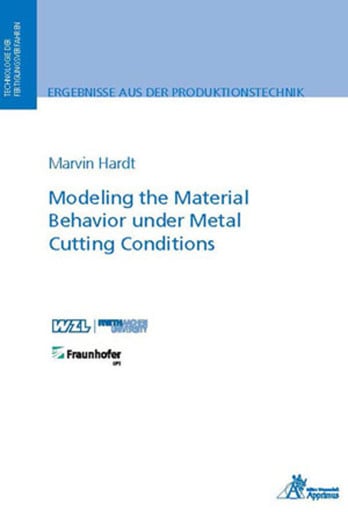
Modeling the Material Behavior under Metal Cutting Conditions

Modeling the Material Behavior under Metal Cutting Conditions

Por Hardt, Marvin

Publicado por Apprimus Wissenschaftsverlag

English 204 páginas 2022 ISBN 9783985550616
Tempo de leitura estimado: 3 h 44 min
PDF

Sobre este livro

The scientific goal of the present work was to model the workpiece material behavior of steels in the metal cutting process depending on the occurring thermo-mechanical loads. The results of this work shall make a significant contribution to the predictive process design of the cutting process by means of Finite Element (FE) simulations for the virtual representation of the reality in the sense of the digital twin. To achieve the objective, extensive empirical examinations were conducted in a first step, which included conventional material scientific and orthogonal cutting tests. This enabled the establishment of a database of the workpiece response with increasing thermo-mechanical loads. During the orthogonal cutting examinations, integral and locally resolved process results were measured, which were used as calibration and validation variables in the modeling of the workpiece material behavior. By extending an established friction test bench with a workpiece pre-heating system, the friction conditions between tool and workpiece could be investigated under conditions equivalent to the cutting process. Based on the experimental results, a friction model was derived, in which the observed effects of thermal softening and the localized adhesion-induced increase in the apparent friction coefficient were superposed. A phenomenological material model was developed to describe the workpiece material behavior in the cutting process. The formulation of the material mode was developed based on empirical examinations as well as results from the state of the art. The material model was implemented in an FE-chip formation simulation using a subroutine. A hybrid optimization algorithm was developed to inversely determine the material model parameters. By means of the optimization algorithm, the material model parameters could be systematically determined inversely, taking the experimentally determined process observables into account. An automated procedure linked to a user interface lowered the entry hurdle for industrial companies and unexperienced users of FE-simulations and reduced the computational effort for the inverse parameter determination to about 10 days of computational execution time. The quality of the developed models and the determined model parameters were further verified by a final deduction step using the industrial example of face turning.

Disponibilidade

Modeling the Material Behavior under Metal Cutting Conditions está disponível como PDF em 8 livrarias online. Entre as livrarias que o vendem estão Bajalibros Argentina, Bajalibros Latam, Bookshop Uruguay.

Categorias

Idioma
English
Compartilhar

Perguntas frequentes

Em quais formatos Modeling the Material Behavior under Metal Cutting Conditions está disponível?
Modeling the Material Behavior under Metal Cutting Conditions está disponível como PDF em 8 livrarias online.
Onde posso comprar Modeling the Material Behavior under Metal Cutting Conditions?
Você pode comprar Modeling the Material Behavior under Metal Cutting Conditions em Bajalibros Argentina, Bajalibros Latam, Bookshop Uruguay. Compare todas as opções na lista desta página.
Quanto tempo leva para ler Modeling the Material Behavior under Metal Cutting Conditions?
Em um ritmo médio de leitura, Modeling the Material Behavior under Metal Cutting Conditions leva cerca de 3 h 44 min para ser lido (204 páginas).

Avaliações e resenhas

Ainda não há avaliações. Seja o primeiro a resenhar este livro.

Entrar para avaliar e resenhar este livro.

Comentários

Entrar para participar da conversa.

Ainda não há comentários.