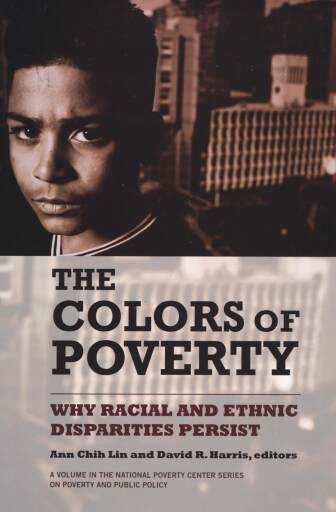
The Colors of Poverty
Publicado por Russell Sage Foundation
English
2008
ISBN 9781610447249
eBook
Buy at Ebooks Agustin
🇪🇸
 Association of University Presses - Tienda FILUNI
🇺🇸
Visitar loja →
Association of University Presses - Tienda FILUNI
🇺🇸
Visitar loja →
 Bajalibros Argentina
🇦🇷
Visitar loja →
Bajalibros Argentina
🇦🇷
Visitar loja →
 Bajalibros Latam
🇺🇸
Visitar loja →
Bajalibros Latam
🇺🇸
Visitar loja →
 Bookshop Uruguay
🇺🇾
Visitar loja →
Bookshop Uruguay
🇺🇾
Visitar loja →
 Catademic
🇺🇸
Visitar loja →
Catademic
🇺🇸
Visitar loja →
Disponível em 13 livrarias
Association of University Presses - Tienda FILUNI
🇺🇸
Visitar loja →
Bajalibros Argentina
🇦🇷
Visitar loja →
Bajalibros Latam
🇺🇸
Visitar loja →
Bookshop Uruguay
🇺🇾
Visitar loja →
Catademic
🇺🇸
Visitar loja →








Sobre este livro
Given the increasing diversity of the nation—particularly with respect to its growing Hispanic and Asian populations—why does racial and ethnic difference so often lead to disadvantage? In The Colors of Poverty, a multidisciplinary group of experts provides a breakthrough analysis of the complex mechanisms that connect poverty and race. The Colors of Poverty reframes the debate over the causes of minority poverty by emphasizing the cumulative effects of disadvantage in perpetuating poverty across generations. The contributors consider a kaleidoscope of factors that contribute to widening racial gaps, including education, racial discrimination, social capital, immigration, and incarceration. Michèle Lamont and Mario Small grapple with the theoretical ambiguities of existing cultural explanations for poverty disparities. They argue that culture and structure are not competing explanations for poverty, but rather collaborate to produce disparities. Looking at how attitudes and beliefs exacerbate racial stratification, social psychologist Heather Bullock links the rise of inequality in the United States to an increase in public tolerance for disparity. She suggests that the American ethos of rugged individualism and meritocracy erodes support for antipoverty programs and reinforces the belief that people are responsible for their own poverty. Sociologists Darren Wheelock and Christopher Uggen focus on the collateral consequences of incarceration in exacerbating racial disparities and are the first to propose a link between legislation that blocks former drug felons from obtaining federal aid for higher education and the black/white educational attainment gap. Joe Soss and Sanford Schram argue that the increasingly decentralized and discretionary nature of state welfare programs allows for different treatment of racial groups, even when such policies are touted as "race-neutral." They find that states with more blacks and Hispanics on welfare rolls are consistently more likely to impose lifetime limits, caps on benefits for mothers with children, and stricter sanctions. The Colors of Poverty is a comprehensive and evocative introduction to the dynamics of race and inequality. The research in this landmark volume moves scholarship on inequality beyond a simple black-white paradigm, beyond the search for a single cause of poverty, and beyond the promise of one "magic bullet" solution. A Volume in the National Poverty Center Series on Poverty and Public Policy
Disponibilidade
The Colors of Poverty está disponível como eBook em 13 livrarias online. Entre as livrarias que o vendem estão Association of University Presses - Tienda FILUNI, Bajalibros Argentina, Bajalibros Latam.
Categorias
- Idioma
- English
Compartilhar
Perguntas frequentes
- Em quais formatos The Colors of Poverty está disponível?
- The Colors of Poverty está disponível como eBook em 13 livrarias online.
- Onde posso comprar The Colors of Poverty?
- Você pode comprar The Colors of Poverty em Association of University Presses - Tienda FILUNI, Bajalibros Argentina, Bajalibros Latam. Compare todas as opções na lista desta página.
Avaliações e resenhas
Ainda não há avaliações. Seja o primeiro a resenhar este livro.
Entrar para avaliar e resenhar este livro.