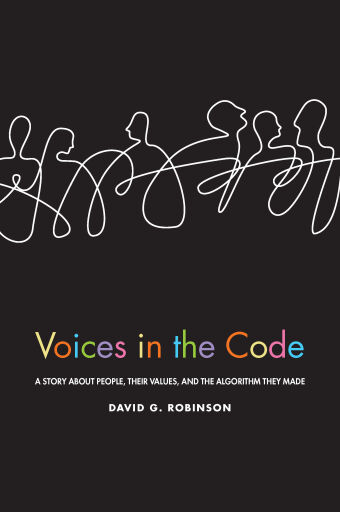
Voices in the Code
Publicado por Russell Sage Foundation
English
2022
ISBN 9781610449144
eBook
Buy at Viubux
🇲🇽
 Association of University Presses - Tienda FILUNI
🇺🇸
Visitar loja →
Association of University Presses - Tienda FILUNI
🇺🇸
Visitar loja →
 Bajalibros Argentina
🇦🇷
Visitar loja →
Bajalibros Argentina
🇦🇷
Visitar loja →
 Bajalibros Latam
🇺🇸
Visitar loja →
Bajalibros Latam
🇺🇸
Visitar loja →
 Bookshop Uruguay
🇺🇾
Visitar loja →
Bookshop Uruguay
🇺🇾
Visitar loja →
 Catademic
🇺🇸
Visitar loja →
Catademic
🇺🇸
Visitar loja →
Disponível em 13 livrarias
Association of University Presses - Tienda FILUNI
🇺🇸
Visitar loja →
Bajalibros Argentina
🇦🇷
Visitar loja →
Bajalibros Latam
🇺🇸
Visitar loja →
Bookshop Uruguay
🇺🇾
Visitar loja →
Catademic
🇺🇸
Visitar loja →








Sobre este livro
Algorithms—rules written into software—shape key moments in our lives: from who gets hired or admitted to a top public school, to who should go to jail or receive scarce public benefits. Such decisions are both technical and moral. Today, the logic of high stakes software is rarely open to scrutiny, and central moral questions are often left for the technical experts to answer. Policymakers and scholars are seeking better ways to share the moral decisionmaking within high stakes software—exploring ideas like public participation, transparency, forecasting, and algorithmic audits. But there are few real examples of those techniques in use.
In Voices in the Code, scholar David G. Robinson tells the story of how one community built a life-and-death algorithm in an inclusive, accountable way. Between 2004 and 2014, a diverse group of patients, surgeons, clinicians, data scientists, public officials and advocates collaborated and compromised to build a new kidney transplant matching algorithm—a system to offer donated kidneys to particular patients from the U.S. national waiting list. Drawing on interviews with key stakeholders, unpublished archives, and a wide scholarly literature, Robinson shows how this new Kidney Allocation System emerged and evolved over time, as participants gradually built a shared understanding both of what was possible, and of what would be fair. Robinson finds much to criticize, but also much to admire, in this story. It ultimately illustrates both the promise and the limits of participation, transparency, forecasting and auditing of high stakes software. The book’s final chapter draws out lessons for the broader struggle to build technology in a democratic and accountable way.
Disponibilidade
Voices in the Code está disponível como eBook em 13 livrarias online. Entre as livrarias que o vendem estão Association of University Presses - Tienda FILUNI, Bajalibros Argentina, Bajalibros Latam.
- Idioma
- English
Compartilhar
Perguntas frequentes
- Em quais formatos Voices in the Code está disponível?
- Voices in the Code está disponível como eBook em 13 livrarias online.
- Onde posso comprar Voices in the Code?
- Você pode comprar Voices in the Code em Association of University Presses - Tienda FILUNI, Bajalibros Argentina, Bajalibros Latam. Compare todas as opções na lista desta página.
Avaliações e resenhas
Ainda não há avaliações. Seja o primeiro a resenhar este livro.
Entrar para avaliar e resenhar este livro.