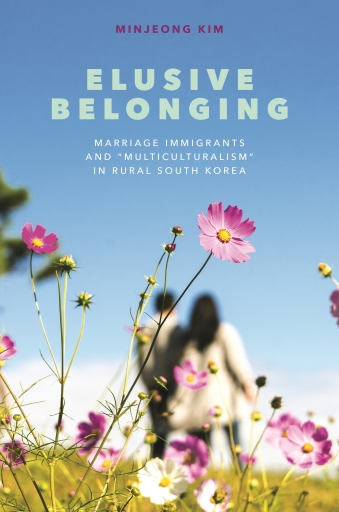
Elusive Belonging
Por Kim, Minjeong
Publicado por University of Hawaii Press
2018
ISBN 9780824873547
English
Available formats
EPUB
eBook
<p><i>Elusive Belonging</i> examines the post-migration experiences of Filipina marriage immigrants in rural South Korea. Marriage migration—crossing national borders for marriage—has attracted significant public and scholarly attention, especially in new destination countries, which grapple with how to integrate marriage migrants and their children and what that integration means for citizenship boundaries and a once-homogenous national identity. In the early twenty-first century many Filipina marriage immigrants arrived in South Korea under the auspices of the Unification Church, which has long served as an institutional matchmaker.<br><br>Based on ethnographic fieldwork, <i>Elusive Belonging</i> examines Filipinas who married rural South Korean bachelors in the first decade of the twenty-first century. Turning away from the common stereotype of Filipinas as victims of domestic violence at the mercy of husbands and in-laws, Minjeong Kim provides a nuanced understanding of both the conflicts and emotional attachments of their relationships with marital families and communities. Her close-up accounts of the day-to-day operations of the state’s multicultural policies and public programs show intimate relationships between Filipinas, South Korean husbands, in-laws, and multicultural agents, and how various emotions of love, care, anxiety, and gratitude affect immigrant women’s fragmented citizenship and elusive sense of belonging to their new country. By offering the perspectives of varied actors, the book reveals how women’s experiences of tension and marginalization are not generated within the family alone; they also reflect the socioeconomic conditions of rural Korea and the state’s unbalanced approach to “multiculturalism.” <br><br>Against a backdrop of the South Korean government’s multicultural policies and projects aimed at integrating marriage immigrants, <i>Elusive Belonging</i> attends to the emotional aspects of citizenship rooted in a sense of belonging. It mediates between a critique of the assimilation inherent in Korea’s “multiculturalism” and the contention that the country’s core identity is shifting from ethnic homogeneity to multiethnic diversity. In the process it shows how marriage immigrants are incorporated into the fabric of Korean society even as they construct new identities as Filipinas in South Korea.</p>
Disponible en 8 librerías
Catademic
🇺🇸
Visitar tienda →
Ebooks Librería Antártica
🇨🇱
Visitar tienda →
Ebooks Agustin
🇪🇸
Visitar tienda →
ebooks Libreria del GAM
🇺🇾
Visitar tienda →
Ebooks Yenny - El Ateneo
🇦🇷
Visitar tienda →
- Language code
- en
Compartir
También te puede interesar
Da gambero a balena
Pacheco Pardo, Ramon
Born Again
Lee, Timothy S.
Isso tudo é encantado
Filho, Florêncio Almeida Vaz, Carvalho, Luciana G. de
The Kebra Nagast
Anonymous
Seeking Order in a Tumultuous Age
Robinson, David M.
Cambio de época: la República de Corea y la renovación de sus relaciones con América Latina
Woo Suk-Kyun, Juan José Ramírez Bonilla, Kim Soon-Bae