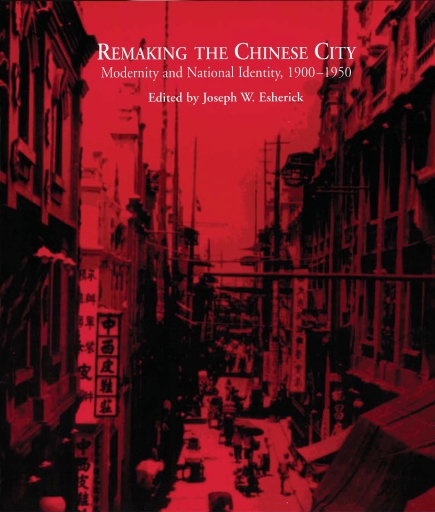
Remaking the Chinese City
Publicado por University of Hawaii Press
Inglés
289 páginas
2000
ISBN 9780824864125
Tiempo de lectura estimado: 5 h 18 min
PDF
Comprar en Viubux
🇲🇽
 Association of University Presses - Tienda FILUNI
🇺🇸
Visitar tienda →
Association of University Presses - Tienda FILUNI
🇺🇸
Visitar tienda →
 Bajalibros Argentina
🇦🇷
Visitar tienda →
Bajalibros Argentina
🇦🇷
Visitar tienda →
 Bajalibros Latam
🇺🇸
Visitar tienda →
Bajalibros Latam
🇺🇸
Visitar tienda →
 Bookshop Uruguay
🇺🇾
Visitar tienda →
Bookshop Uruguay
🇺🇾
Visitar tienda →
 Catademic
🇺🇸
Visitar tienda →
Catademic
🇺🇸
Visitar tienda →
Disponible en 16 librerías
Association of University Presses - Tienda FILUNI
🇺🇸
Visitar tienda →
Bajalibros Argentina
🇦🇷
Visitar tienda →
Bajalibros Latam
🇺🇸
Visitar tienda →
Bookshop Uruguay
🇺🇾
Visitar tienda →
Catademic
🇺🇸
Visitar tienda →











Sobre este libro
In China today skyscrapers tower over ancient temples, freeways deliver lines of cars and tour buses to imperial palaces, cinema houses compete with old theaters featuring Peking Opera. The disparity evidenced in the contemporary Chinese cityscape can be traced to the early decades of the twentieth century, when government elites sought to transform cities into a new world that would be at once modern and distinctly Chinese. Remaking the Chinese City aims to capture the full diversity of recent Chinese urbanism by examining the modernist transformations of China's cities in the first half of the twentieth century.
Collecting in one place some of the most interesting and exciting new work on Chinese urban history, this volume presents thirteen essays discussing ten Chinese cities: the commercial and industrial center of Shanghai; the old capital, Beijing; the southern coastal city of Canton; the interior's Chengdu; the tourist city of Hangzhou; the utopian "New Capital" built in Manchuria during the Japanese occupation; the treaty port of Tianjin; the Nationalists' capital in Nanjing; and temporary wartime capitals of Wuhan and Chongqing.
Unlike past treatments of early twentieth-century China, which characterize the period as one of failure and decay, the contributors to this volume describe an exciting world in constant and fundamental change. During this time, the Chinese city was remade to accommodate parks and police, paved roads and public spaces. Rickshaws, trolleys, and buses allowed the growth of new downtowns. Department stores, theaters, newspapers, and modern advertising nourished a new urban identity. Sanitary regulations and traffic laws were enforced, and modern media and transport permitted unprecedented freedoms. Yet despite their fondness for things Western and modern, early urban planners envisioned cities that would lead the Chinese nation and preserve Chinese tradition. The very desire for modernity led to the construction of a visible and accessible national past and the imagining of a distinctive national future. In their investigation of the national capitals of the period, the essays show how cities were reshaped to represent and serve the nation. To promote tourism, traditions were invented and recycled for the pleasure and edification of new middle-class and foreign consumers of culture.
Abundantly illustrated with maps and photographs, Remaking the Chinese City presents the best and most current scholarship on modern Chinese cities. Its thoroughness and detailed scholarship will appeal to the specialist, while its clarity and scope will engage the general reader.
Contributors: Michael Tsin on Canton, Ruth Rogaski and Brett Sheehan on Tianjin, David Buck on Changchun, Kristin Stapleton on Chengdu, Liping Wang on Hangzhou, Madeleine Dong on Beijing, Charles Musgrove on Nanjing, Stephen MacKinnon on Wuhan, Lee MacIsaac on Chongqing, and Jeffrey Wasserstrom and David Strand with concluding essays.
Disponibilidad
Remaking the Chinese City está disponible como PDF en 16 librerías online. Entre las librerías que lo venden están Association of University Presses - Tienda FILUNI, Bajalibros Argentina, Bajalibros Latam.
- Idioma
- Inglés
Compartir
Preguntas frecuentes
- ¿En qué formatos está disponible Remaking the Chinese City?
- Remaking the Chinese City está disponible como PDF en 16 librerías online.
- ¿Dónde puedo comprar Remaking the Chinese City?
- Puedes comprar Remaking the Chinese City en Association of University Presses - Tienda FILUNI, Bajalibros Argentina, Bajalibros Latam. Compara todas las opciones en la lista de esta página.
- ¿Cuánto se tarda en leer Remaking the Chinese City?
- A un ritmo de lectura medio, Remaking the Chinese City se lee en unas 5 h 18 min (289 páginas).
Valoraciones y reseñas
Aún no hay valoraciones. Sé el primero en reseñar este libro.
Acceder para valorar y reseñar este libro.